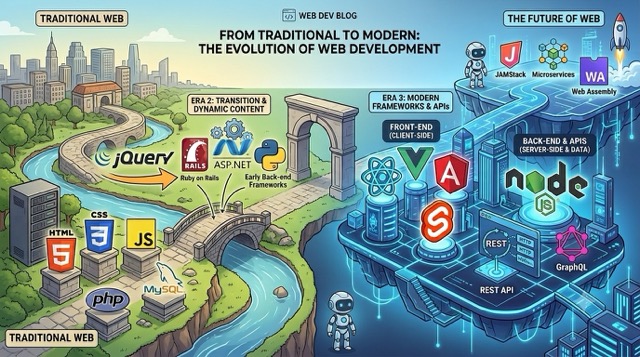
The web has evolved from a simple collection of interconnected text documents into a highly complex, real-time global software ecosystem. Operating as an effective full-stack engineer today requires more than just copying code; it demands a deep understanding of how client-side user interfaces, server-side business logic, databases, and cloud infrastructure weave together into a seamless experience.
1. The Evolution of the Web: From Static Text to Dynamic Applications
In the early 1990s, the web was entirely static. Websites were written in pure HTML—documents served straight from a machine's hard drive to a browser. There were no databases or styling rules; just hyperlinked text. As the internet grew, the demand for visual identity led to the birth of CSS (Cascading Style Sheets), allowing developers to separate content from presentation.
The real shift began when web pages needed to become functional. In 1995, JavaScript was created to give browsers native execution capabilities. Suddenly, forms could be validated before sending data, and drop-down menus could animate without reloading the whole page.
On the server side, languages like PHP revolutionized the industry by embedding logic directly inside HTML. Instead of serving an identical file to every visitor, PHP allowed developers to fetch user data from a database and build unique pages on the fly. This catalyzed the era of Content Management Systems (CMS), most notably WordPress, which still powers a massive percentage of the internet today by abstracting coding entirely away for content creators.
2. Modern Frontend Architecture: Styling, Logic, and Frameworks
As user expectations spiked, building large-scale layouts with raw HTML, CSS, and jQuery became unmanageable. The industry adapted by moving toward reusable components and utility-first design systems.
- Utility-First Design (Tailwind CSS): For years, component libraries like Bootstrap reigned supreme. Today, the pendulum has swung toward Tailwind CSS. It is a utility-first framework that allows developers to write low-level CSS classes directly inside their markup, providing absolute design freedom without bloated, tangled stylesheet files.
- The Single Page Application (SPA): Modern websites behave more like native desktop apps. React introduced a component-driven architecture based on a "Virtual DOM." By tracking state changes internally, React ensures that changing a specific piece of data only redraws that exact fragment of the user interface, rather than reloading the whole page.
- Type Safety at Scale (TypeScript): Standard JavaScript is dynamically typed, meaning variable formats can change unexpectedly, causing subtle runtime crashes. TypeScript solves this by adding explicit type definitions on top of JavaScript. It acts as a strict compiler, catching logical errors during development long before the code ever reaches a user's browser.
- Meta-Frameworks (Next.js): While pure React runs entirely in the user's browser (Client-Side Rendering), it struggles with slow initial load times and Search Engine Optimization (SEO). Next.js bridges this gap by offering Server-Side Rendering (SSR) and Static Site Generation (SSG), pre-building the page safely on the server and handing it off to the client for instant interactivity.
3. Backend Engines, Frameworks, and API Paradigms
The backend is the brain of your application. It handles user authentication, business workflows, database queries, and background calculations. Over the years, backend architecture has split into several dominant ecosystem paths:
- The Node.js Revolution: Traditionally, JavaScript lived only in the browser. Node.js brought Google's V8 JavaScript engine to the server. Running on an asynchronous, event-driven, non-blocking I/O model, Node.js is exceptionally efficient at handling thousands of concurrent data streams (ideal for real-time chat apps or live dashboards).
- Enterprise PHP (Laravel): Modern PHP is incredibly structured, championed by Laravel. Laravel provides an elegant, expressive syntax and a "batteries-included" ecosystem featuring an intuitive Object-Relational Mapper (Eloquent), integrated routing, user queues, and robust security protocols out of the box.
- High-Performance Python (Django & FastAPI): Python backends are the gold standard for data-heavy and AI applications. Django provides a rapid-development environment with an integrated admin panel. Conversely, FastAPI is built for minimalist, high-speed execution, utilizing Python type hints to auto-generate API documentation while running at speeds comparable to Go or Node.js.
Connecting the Layers: Frontend and backend layers communicate via APIs. The classic approach is REST (Representational State Transfer), utilizing standard HTTP verbs (GET, POST, PUT, DELETE) across structured URLs. For complex, highly nested data, modern teams utilize GraphQL, which lets the frontend request the exact data shapes it needs in a single trip, eliminating over-fetching.
4. Data Persistence: Choosing the Right Database Layer
An application is only as reliable as its data storage. Full-stack developers must understand the core trade-offs between different database categories:
- Relational (SQL) Databases: Systems like PostgreSQL, MySQL, and SQLite. These rely on strict tables, rows, and structured foreign key relationships. They offer strong ACID compliance, making them the absolute best choice for e-commerce systems, financial accounting, and applications with rigid data models.
- Non-Relational (NoSQL) Databases: Systems like MongoDB and DynamoDB. These use schema-less, flexible document formats (like JSON/BSON structures) and scale horizontally with ease. They are ideal for content management, diverse user profiles, real-time analytics, and rapid prototyping where the data shape changes frequently.
- In-Memory Caching: Systems like Redis and Memcached. These store key-value pairs purely in system RAM for near-zero latency retrieval. They are heavily utilized for session storage, API rate-limiting, and caching heavy database queries to reduce server load.
5. The Rise of Defined Architecture Stacks
To streamline production, software engineering patterns naturally group compatible technologies into standardized "stacks." Knowing these predefined architectures makes collaboration and scaling far cleaner:
- MERN Stack: MongoDB, Express.js, React, Node.js. A completely unified JavaScript pipeline from the front to the back, enabling rapid, modern single-page app development.
- LAMP/LEMP Stack: Linux, Apache/Nginx, MySQL, PHP. The classic, bulletproof foundation that powers legacy enterprise sites, custom Laravel backends, and millions of WordPress deployments globally.
- T3 / Modern Stacks: Next.js, TypeScript, Tailwind CSS, Prisma ORM. Designed specifically for peak type-safety, rapid layout styling, and optimized web vitals out of the box.
6. The Software Lifecycle: From Local Code to Production Cloud
Writing working code on your local computer is only half the battle. Bringing that application to live users requires moving through a structured delivery pipeline:
[attachment_0](attachment)- Version Control (Git & GitHub): Every line of code should live inside a Git repository. Developers use branches to build features separately, merging them back into the main pipeline via pull requests that are peer-reviewed for quality.
- Containerization (Docker): To avoid the phrase "It works on my machine but breaks in production," applications are packed into Docker containers. These encapsulate the application code along with its exact operating system and libraries, ensuring it executes identically on any machine.
- CI/CD Pipelines: Continuous Integration and Deployment platforms (like GitHub Actions) monitor your repository. Whenever code is pushed, automated servers instantly spin up, execute test suites to check for bugs, build production assets, and handle deployment without manual human intervention.
Hosting and Cloud Providers
Where your code actually runs depends entirely on your operational scale and budget:
- Shared & VPS Hosting (Hostinger, Bluehost): Traditional servers where you manually manage files (often via cPanel or FTP). Perfect for small businesses, portfolios, and standard WordPress installations.
- Platform-as-a-Service (Vercel, Netlify): Zero-configuration platforms optimized for modern web apps. You simply connect your GitHub repository, and they instantly compile, optimize, and deploy your Next.js or React frontend apps to global edge networks.
- Enterprise Cloud Infrastructure (AWS, Google Cloud): The heavyweight giants. These platforms provide raw computing power, managed databases, cloud storage buckets, and serverless architecture. They require complex DevOps configuration but offer infinitely scalable infrastructure to support millions of concurrent global requests.
Full-stack web development isn't a fixed destination; it's an evolving landscape. Frameworks will change, language features will update, and hosting platforms will consolidate. The best engineers are not those who memorize specific syntax, but those who understand foundational concepts—how data travels across HTTP networks, how databases manage transactions safely, and how to write clean, maintainable, user-focused software layers.