The computer is arguably humanity’s greatest invention—a synthetic extension of the human mind. What began as room-sized mechanical calculators processing basic arithmetic has evolved into a global, interconnected nervous system of silicon and light. To truly master computer science, we must dissect this "computational brain" from the lowest subatomic physics of a microchip all the way up to global networking protocols.
1. The Evolution of the Form Factor: From Mainframes to Nanotech
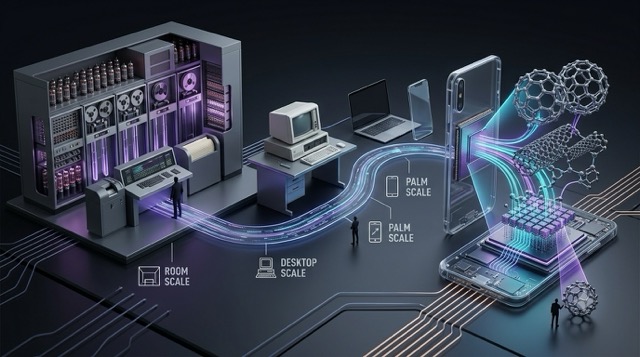
The journey of computing power is governed by Moore’s Law, the historical observation that the number of transistors on a microchip doubles roughly every two years, driving performance up and costs down. This exponential miniaturization has completely transformed how we interact with machines:
- The Room-Sized Era (1940s-1970s): Early computers like the ENIAC relied on fragile vacuum tubes, eventually giving way to the first commercial mainframes. These machines were massive, generating immense heat, and were operated via punch cards.
- The Personal Computer (1980s-2000s): The invention of the integrated circuit and the microprocessor condensed the power of a mainframe into a silicon chip the size of a coin. This birthed the PC era, putting dedicated computing power on individual desks.
- The Smartphone Revolution (2010s): Processors became hyper-efficient (thanks to ARM architecture). Today's standard smartphone possesses exponentially more raw computational power than the systems used to land the Apollo 11 mission on the moon, packed into a pocket-sized glass slab.
- Wearables & Nanotechnology (Present & Future): The form factor is dissolving. We are currently shrinking compute nodes into smartwatches, augmented reality glasses, and biometric sensors. On the bleeding edge, Nanotechnology is exploring atomic-scale transistors and biological computing, where microscopic nano-bots could soon navigate the human bloodstream to detect diseases.
2. The Language of Machines: Bits, Bytes, and Translation
At its absolute lowest physical level, a processor has no concept of language, images, or logic. It only understands voltage: an electrical current is either flowing (1) or it is blocked (0). This is the binary system.
- Bit: A single binary digit (0 or 1).
- Byte: A sequence of 8 bits, capable of representing a single character like the letter 'A'.
- Kilobyte (KB) & Megabyte (MB): 1,024 Bytes make a KB (a short text document). 1,024 KBs make an MB (a high-res photo).
- Gigabyte (GB) & Terabyte (TB): 1,024 MBs make a GB (a movie). 1,024 GBs make a TB (a massive modern hard drive).
- Petabyte (PB) & Beyond: 1,024 TBs make a PB. This is the scale of massive enterprise data centers, global AI training datasets, and internet traffic routing.
Because humans cannot effectively write software in billions of 1s and 0s, we created layers of abstraction to translate our logic down to the hardware:
- High-Level Languages (Python, Java, C++): Human-readable code featuring English-like syntax and mathematical logic.
- Compilers & Interpreters: A Compiler takes your entire high-level program and translates it all at once into a runnable machine-code file. An Interpreter translates and executes the code line-by-line in real-time.
- Assembly Language: A very low-level language one step above binary, using short mnemonics (like ADD, MOV, SUB) to directly control CPU memory registers.
- Assembler: The specialized program that translates Assembly mnemonics directly into pure Machine Code.
- Instruction Decoder: Once the binary machine code hits the CPU, the hardware's internal decoder physically translates those 1s and 0s into the exact electrical signals needed to fire the correct transistors.
3. Hardware Architecture: The Physical Brain
If software is the mind, the hardware is the physical brain. Modern computing architectures rely on three massive technological pillars:
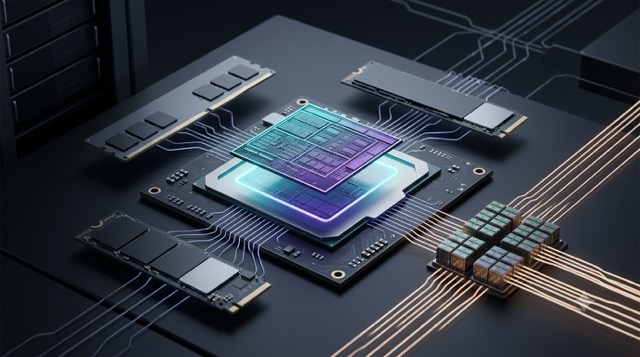
- The Central Processing Unit (CPU): The master conductor. Modern CPUs are fabricated on 3-nanometer processes, packing tens of billions of microscopic transistors. The CPU contains the Control Unit (which fetches and decodes instructions) and the Arithmetic Logic Unit (ALU) (which performs the actual mathematical execution).
- The Graphics Processing Unit (GPU): While a CPU has a few incredibly fast, smart cores designed for complex sequential tasks, a GPU has thousands of smaller, simpler cores designed to do math in parallel. Originally built for rendering 3D video game pixels, modern GPUs (with specialized Tensor cores) are now the primary engines powering the Artificial Intelligence and Deep Learning boom.
- Storage & Memory: Data lives in a strict hierarchy. Long-term storage has evolved from magnetic spinning hard drives to NVMe Solid State Drives (SSDs) that use 3D NAND flash memory to retrieve data at gigabytes per second. Active data is loaded into RAM (Random Access Memory) for rapid access, and the most immediate data is pushed directly into the CPU's internal L1/L2 Cache.
4. The Software Layer: Systems and Applications
Hardware without software is just expensive sand. The software layer breathes life into the silicon, split into two primary categories:
- System Software (The Operating System): The OS (Windows, Linux, macOS, Android) is the fundamental resource manager. Its core, the Kernel, dictates exactly how much CPU time, memory, and network access every program receives, preventing the system from crashing under conflicting demands.
- Application Software: The programs you actually interact with—web browsers, video games, IDEs, and databases. These applications never touch the hardware directly; they politely ask the OS to allocate resources for them.
5. The Nervous System: Networking and TCP/IP
A single computer is powerful, but billions of connected computers change the world. In networking, a Host is any device connected to a network.A Server provides resources (like web pages or databases), while Clients (like your laptop or smartphone) request and consume them. These devices connect via a LAN (Local Area Network) within a single building, or a WAN (Wide Area Network) which links multiple local networks across the globe to form the internet.
To communicate globally without total chaos, machines rely on TCP/IP (Transmission Control Protocol / Internet Protocol). While every device has a permanent, physical MAC address stamped on its network card for local identification, it uses a logical IP address for global routing. IP handles this worldwide addressing, while TCP ensures data packets arrive reliably. Because humans cannot memorize numerical IP addresses, Domains (www.bishalmondal.online) serve as readable aliases. Hosting companies provide the physical server infrastructure tied to these domains, storing your files and serving them to clients worldwide.
6. The Spectrum of Computing Power: From PCs to Quantum Realities
Not all computational brains are built for the same purpose. Today, machines are categorized strictly by their architectural capabilities:
- Personal Computers (PCs): Designed for highly responsive, single-user utility. Optimized for dynamic, varied tasks like web browsing, gaming, and local software compilation.
- Mainframes: The workhorses of the global financial system. Mainframes are not designed for peak single-task speed, but for absolute reliability and massive transaction throughput. They can process billions of credit card transactions or flight bookings simultaneously with zero downtime.
- Supercomputers: The ultimate brute-force calculators. Supercomputers string together hundreds of thousands of CPU and GPU cores to simulate entire galaxies, map the human genome, or predict global weather patterns. Their speed is measured in PFLOPS (Peta-Floating Point Operations Per Second).
The Frontier: Quantum Computing
Traditional computers—even the most massive supercomputers—are strictly bound by binary physics (0 or 1). Quantum Computers abandon this entirely.
Instead of bits, they use Qubits. Thanks to a quantum mechanical property called Superposition, a qubit can exist as a 0, a 1, or both simultaneously. Furthermore, through Entanglement, the state of one qubit can instantly influence another, regardless of physical distance.
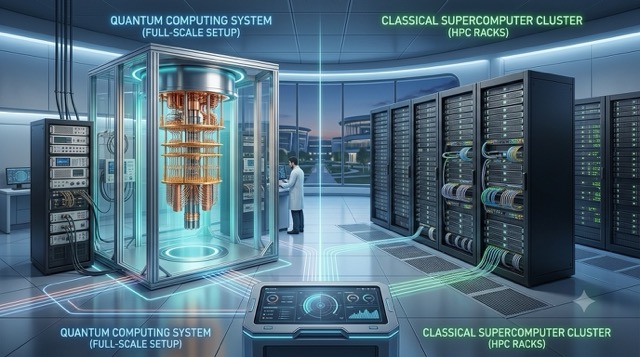
This allows quantum computers to process massive combinatorial probabilities all at once, rather than one-by-one. In the near future, quantum architectures will be able to crack modern cryptographic security in seconds, discover new chemical compounds instantly, and solve logistics problems that would take a traditional supercomputer millions of years to calculate.
From the vacuum tubes of the 1940s to the cryogenic quantum processors of tomorrow, the computational brain represents the absolute bleeding edge of human ingenuity. Understanding this architecture is no longer just about writing code; it is about grasping the very mechanics of how the modern world operates, scales, and evolves.