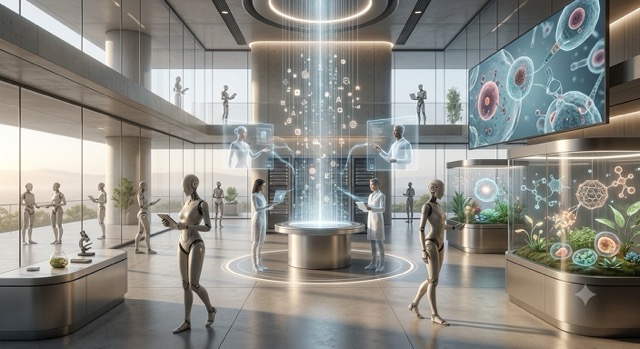
We have officially crossed the threshold. Artificial Intelligence in 2026 isn't just about generating text prompts; it is a living, interconnected ecosystem of autonomous digital engineers, dynamic spatial computing, and physical entities navigating our world.
1. The Titan Clash: Frontier LLMs and Market Competition
The traditional 18-month model release cycle is completely dead. The first half of 2026 has seen an unprecedented compression of frontier model drops, transforming the competition between tech giants into a war of raw efficiency and cognitive depth.
OpenAI’s GPT-5.5 has positioned itself as the heavy-duty operating system for broad, complex reasoning, handling multi-layered problem solving effortlessly. Anthropic fired back with Claude Opus 4.8, completely dominating the software engineering sector. Its terminal-integrated "Claude Code" environment can natively jump into massive enterprise codebases, run tests, diagnose bugs, and push pull requests entirely on its own.
Google DeepMind’s Gemini 3.1 Pro has broken records by scaling its native context window to a massive 2.1 million tokens, allowing users to parse whole libraries of research papers or hours of video in a single look. Meanwhile, xAI’s Grok 4 leverages live, unfiltered data pipelines to serve as the fastest engine for real-time social context and rapid coding execution. Not to be outdone, open-source models like DeepSeek V4 are now matching these proprietary benchmarks at a fraction of the cost, completely changing how lean startups build AI products.
2. Agentic AI: From Assistants to Digital Employees
The tech industry has shifted from simple conversational "chatbots" to autonomous Agentic AI. We are no longer just chatting with AI; we are managing it. Modern agents possess long-horizon planning abilities, meaning they can take a high-level goal, break it down into dozens of sub-tasks, and execute them over days without needing a human to click "continue."
Today's workflows rely heavily on multi-agent collaboration. In advanced development environments, companies use multi-agent debates where specialized AI personas—such as an AI Architect, an AI Developer, and an AI Security Reviewer—argue back and forth to stress-test code logic before it ever touches a production server.
3. Production Optimization: Lean Workflows & Fine-Tuning
While massive foundation models handle the heavy lifting, practical industrial software requires deep, specialized domain fine-tuning. Building these apps means optimizing your deployment pipelines for speed and reliability.
When serving a fine-tuned natural language processing application via a web framework like Streamlit, cloud resource constraints are a constant battle. Modern developers are stripping their deployment payloads to the absolute minimum. By pushing only the core weights (using light, secure formats like safetensors) and completely omitting heavy training artifacts like optimizer files, you can easily bypass strict file size limits on GitHub and Hugging Face while dramatically accelerating inference speeds for the end user.
4. Multimodal Mastery: Image, Video, and Spatial Computing
The concept of static "text-to-image" has evolved into true "any-to-any" multimodality. Models now process text, audio, images, and live video feeds simultaneously. Google’s Gemini Omni allows users to edit video frames dynamically using real-time voice conversations, making digital design feel as natural as talking to a colleague.
For creative media production, models like Nano Banana 2 (Gemini 3 Flash Image) have mastered multi-image prompting and style transfer, blending distinct visual references into entirely new, cohesive scenes. In the video domain, OpenAI’s Sora and Google’s Veo generate high-fidelity video clips that respect real-world physics, complete with automatically generated, perfectly synchronized audio tracks. These dynamic assets are directly fueling AR and VR spatial computing platforms, generating immersive 3D environments on the fly.
5. Transfer Learning and Physical Vision Systems
This native spatial understanding has unlocked incredible real-world tracking capabilities. By applying transfer learning to massive multimodal video models, developers are building highly adaptive computer vision systems without needing millions of new training images.
A prime example of this is the massive leap forward in automated sign language translation and hand gesture recognition. By feeding pre-trained vision networks specialized sequences of motion data, these applications can track subtle hand movements, joint angles, and facial expressions simultaneously. This bridges communication gaps in real-time, translating fluid, non-verbal language into spoken text with remarkable precision.
6. Embodied AI and the Humanoid Fleet
AI has stepped out of the digital world and into physical reality. 2026 is officially the year of the humanoid robot. Instead of writing millions of lines of rigid, rule-based code to tell a robot how to move, engineers are training vision-language-action models that output continuous "action chunks"—predictive sequences of physical joint movements based on what the robot sees.
Using simulation environments like NVIDIA's Isaac GR00T, these robots practice physical tasks millions of times in virtual worlds before a single line of motor code is sent to the physical hardware. Tesla's Optimus Gen 2 and Boston Dynamics' Electric Atlas are already moving past laboratory testing and taking over unstructured logistics on real factory floors. At the same time, consumer-facing models like 1X’s NEO are entering homes, using a blend of safe, squishy hardware mechanics and teleoperation-to-autonomy models to learn how to tidy rooms and assist with daily chores safely around humans.
7. The Convergence of Biotech and Nanotech
Perhaps the most profound impact of AI is happening at the microscopic level, where machine learning has completely broken the traditional R&D timeline. In biotechnology, AI simulation platforms have compressed preclinical drug discovery from an agonizing four years down to roughly 14 months, predicting exactly how new molecular formulas will interact with human biology before they ever enter a physical lab.
Simultaneously, AI is driving a revolution in nanotechnology. By simulating molecular structures at atomic scales, researchers are designing smart biomaterials that can change their properties in response to heat or pressure, alongside ultra-lightweight composites that are exponentially stronger than steel. From targeted, nanoscale medical therapies to self-healing materials, AI is giving us direct control over the building blocks of matter itself.
The intelligence age is no longer approaching; it has settled into our codebases, our hardware, and our biology. The only question left is how quickly we choose to build alongside it.